
An AI LinkedIn post generator writes a post from a short prompt, so the ideas come from the model. An AI ghostwriter writes from a conversation with you, so the ideas come from you and the AI only does the writing. Outerview works as an AI ghostwriter: it interviews you, then writes LinkedIn posts in your voice, using nothing you didn't say.
- A generator starts from a prompt. A ghostwriter starts from you. A prompt carries a topic and a tone. A conversation carries the client, the number and the mistake, which is what people actually read.
- Human ghostwriters work, but they're priced per person. About €1,500 a month each in the Nordics, so most firms ghostwrite for one partner and leave the rest of their experts silent.
- An AI ghostwriter keeps the interview and automates the writing. Outerview asks the questions, writes the drafts in your voice, and traces every line back to the transcript. You approve every post.
- People get read. Company pages mostly don't. In our research, Finland's top LinkedIn creators posted 113 times a year on average. The company pages of 846 Finnish B2B firms posted 6 times.
- Use a generator for volume and a ghostwriter for substance. If you already know exactly what to say, a generator is fast. If the hard part is finding what's worth saying, you need someone, or something, to ask.
Presidents, kings and queens have used ghostwriters for as long as there have been speeches. Nobody calls those speeches fake. The words were written by someone else, but the thinking came from the person on stage.
That’s the part most AI LinkedIn post generators skip. They kept the writing and threw away the conversation.
I’m one of the founders of Outerview, and we build an AI tool for LinkedIn posts. So yes, we’re “an AI LinkedIn post generator” too, in the sense that people search for it. But we built it the way a ghostwriter works, and this post explains why.
The difference in one table
| AI LinkedIn post generator | Human ghostwriter | AI ghostwriter (Outerview) | |
|---|---|---|---|
| Where the ideas come from | Your prompt and the model’s general knowledge | A call with you, plus their own research | An interview with you |
| Your effort | Write a prompt, then edit a lot | A monthly call, then review | 20 minutes of talking, then review |
| Sounds like you | Yes, if you prompt it well | Depends on the writer | Learned from how you talk and every edit you make |
| Made-up claims | Possible, and hard to spot | Rare, but you trust the writer | Every line traced to the transcript |
| Price | The cheapest, often covered by a ChatGPT or Claude plan you already pay for | About €1,500 per person a month | €99 a month, €399 for a team of five |
What a generator does well
I’ll be fair to generators, because I use AI for almost everything I build.
If you already know exactly what you want to say, a generator is fast. Paste a bullet list, get a clean post, change two sentences, publish. For announcements, event recaps and job ads, that’s often enough.
My colleague Julius compared the main tools in Why AI Post Generators Don’t Sound Like You. The short version: they’re good at writing and bad at knowing what you think.
Where generators go wrong: they write from nothing
A prompt like “write a LinkedIn post about customer experience” gives the model a topic and nothing else. So it fills the gap with what it knows: the average of every post about customer experience it has ever seen.
That’s how you get the posts everyone scrolls past. Correct, polite, and not about anything that happened.
Our rule at Outerview is the opposite: nothing gets generated from zero. Every idea in a post has to come from the person. The AI’s job is to make the writing easy, not to have the opinions.
This matters more than it sounds. In our study of 10,960 posts by 340 of Finland’s top LinkedIn creators, posts built on the writer’s own experience got 46% more reactions than that writer’s usual post. Only 7.7% of posts were built that way. A generator can’t write that kind of post, because it doesn’t have your experience. It only has your prompt.
What a ghostwriter actually sells is the conversation
A good human ghostwriter doesn’t sell sentences. They sell the hour where they ask you questions until the interesting thing falls out. “Wait, why did you do it that way?” is where the post comes from.
The problem is price. A LinkedIn ghostwriter in the Nordics costs about €1,500 per person per month. That’s why most firms ghostwrite for one partner, maybe the CEO, and leave everyone else silent. (We wrote up the full numbers in Outerview vs a LinkedIn ghostwriter.)
So we asked a simple question: what if the AI did the ghostwriter’s job, interview included?
Why we built an interviewer
This came from our previous company. There we built websites for big brands, and we kept seeing the same thing. The launch looked great. Then the site needed content, and nobody had time to write it. Getting experts across the company to help with marketing was always the hardest part.
We had the same problem ourselves. Our clients had it. So we built the fix, and now we use it for our own marketing too. This post started as an interview in Outerview.
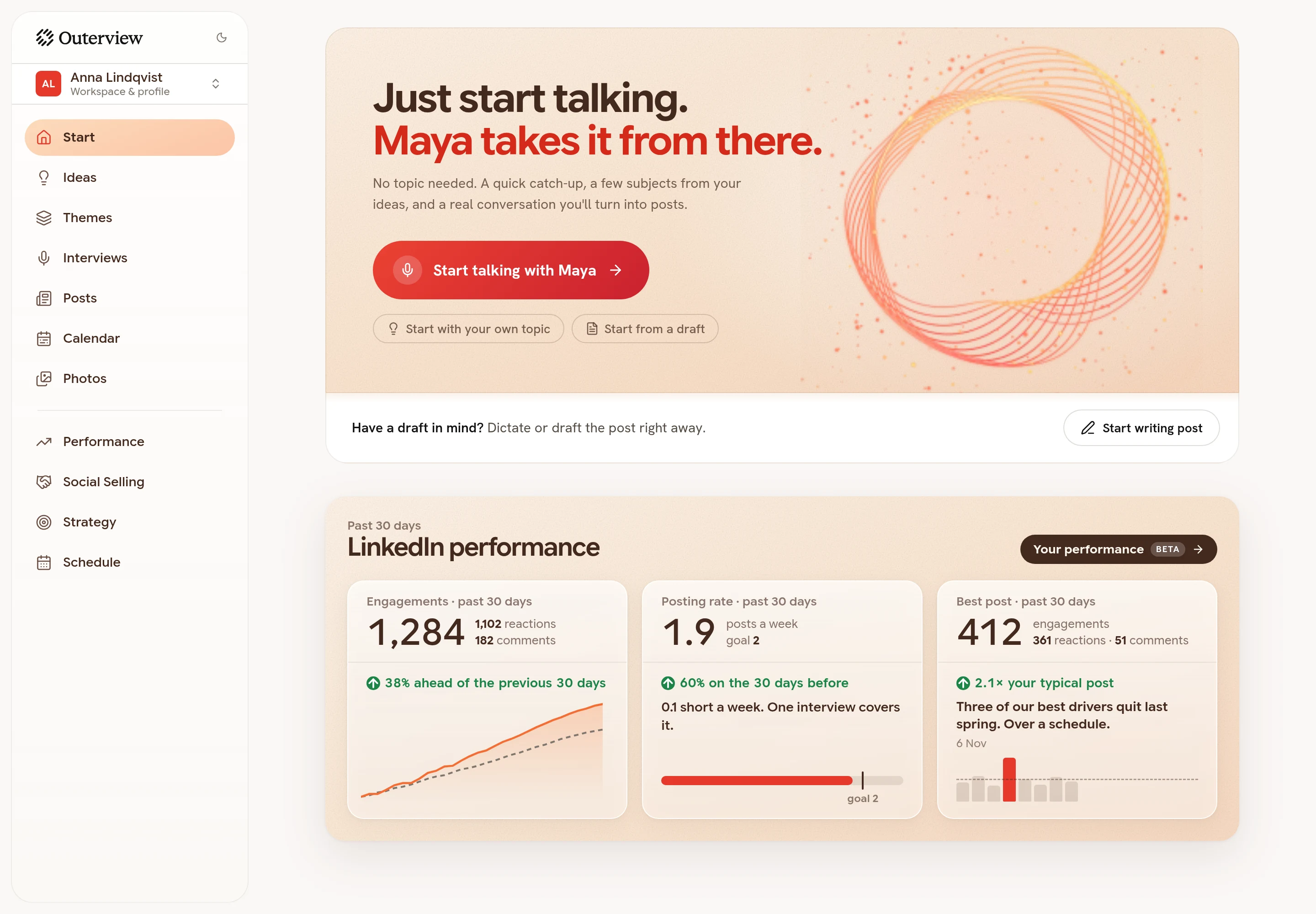
How an AI ghostwriter works in practice
Here’s what Outerview does, step by step.
It gets to know you first. It reads your LinkedIn profile and suggests topics that matter to you. Starting from your own topic is a lot easier than starting from a blank page.
It interviews you. You talk for around 20 minutes, by voice or text, like a normal conversation. The questions follow what you actually say. Every interview adds context, so the next topic suggestions get better.
It writes from the transcript. You get LinkedIn posts in your voice, and long-form articles when the conversation goes deep enough. Every line traces back to something you said, and anything the transcript doesn’t back up gets flagged.
It learns from your edits. You fix a draft, and it notices what you changed. I make my drafts messier and funnier than the AI does, and it’s slowly learning to let me.
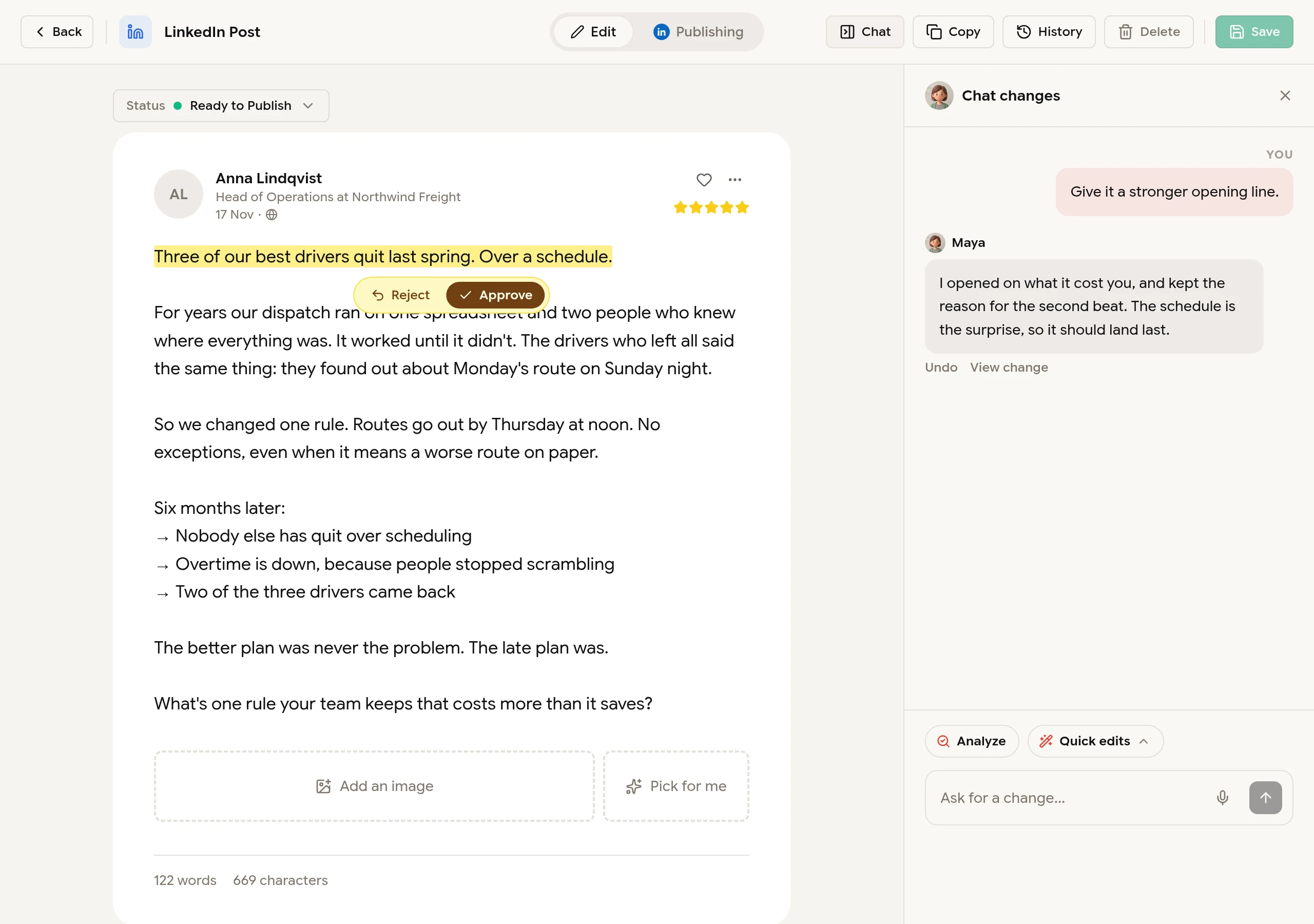
You decide what gets posted. Nothing goes out until you approve it. Then it posts on your schedule.
It shows who’s listening. When people react to and comment on your posts, Outerview’s social selling view shows who they are and which of them look like buyers.
People get read, company pages don’t
One more reason we built this for people instead of brands.
In our research, Finland’s top LinkedIn creators posted 113 times a year on average. The company pages of 846 Finnish B2B firms posted 6 times. That’s a 19× gap. And it matches what everyone feels in their own feed: you follow people, not logos.
The same goes for AI search. ChatGPT, Gemini and Claude answer questions about companies using what’s written about them online, and LinkedIn is a big part of that. If your experts post, your company shows up. Outerview checks this too, by asking those assistants the questions your buyers ask and seeing who gets named.
The best version of this is when a company’s quietest experts start talking. They’re usually the ones clients most want to hear from, and the ones who’d never write a post on their own.
Which one should you use?
Use an AI LinkedIn post generator when you already know what you want to say and just need it written fast.
Use a human ghostwriter when you want one person publishing exceptionally well and the budget isn’t a problem.
Use an AI ghostwriter like Outerview when the hard part is finding what’s worth saying, or when you want more than one person on your team posting in their own voice.
You can try it on yourself: the free plan gives you one interview a month, with no card.
Have something to say but no time to write it? Talk it through with an interviewer at outerview.app.
Frequently asked
What's the difference between an AI LinkedIn post generator and an AI ghostwriter?
A generator turns a prompt into a post, so the content comes from the model's general knowledge. An AI ghostwriter interviews you first and writes only from what you said, so the content is yours and the AI does the writing.
How much does a LinkedIn ghostwriter cost?
In the Nordics, a human LinkedIn ghostwriter costs roughly €1,000–2,000 per person per month for a few posts a week. Outerview costs €99 a month for one person and €399 a month for a team of five.
Can an AI LinkedIn post generator sound like me?
Only as much as the material it gets. A generator that learns from your old posts copies how you write when you're polishing. An interview captures how you talk when you explain something, which is closer to your real voice.
Is there a free AI ghostwriter for LinkedIn?
Outerview has a free plan: one interview a month, with up to ten posts from it, and no credit card.
Will AI-written LinkedIn posts hurt my credibility?
Posts with made-up claims will. Outerview only writes from what you said in the interview, flags anything the transcript doesn't back up, and publishes nothing until you approve it.