Why the People with the Best Ideas Don't Post
Most people with real expertise freeze at the blank page. I built an AI interview tool to fix that. Here's why conversation beats writing.

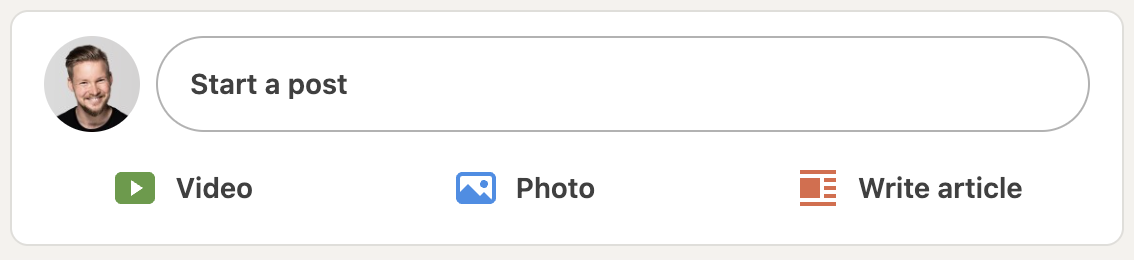
Open LinkedIn. Hit “Start a post.” Stare at the cursor.
Close the tab.
If that’s you, you’re not lazy. You’re just starting in the wrong place. Writing from a blank page is a performance. And most people who actually know things aren’t performers.
I ran a company for 13 years. Scaled it to 75 people, exited, the whole thing. Over a decade of mentoring founders, coaching teams, solving messy problems in real-time conversations. In those moments I could pull from experience, connect dots, say something that actually landed.
But ask me to open LinkedIn and write from scratch?
I’d freeze. Every single time. 😅
Took me a while to figure out why. Writing asks you to already know what you think before you start typing. Conversation lets you figure it out as you go. Those are completely different cognitive activities. And LinkedIn is built for only one of them.
The people who struggle most with this have the most to say
The people who freeze at the blank page aren’t the ones with nothing worth saying. They’re the ones actually doing the work. Living in the contradictions. Carrying years of hard-won knowledge they’ve never figured out how to get out of their heads.
Meanwhile, the people who post four times a week are often the ones who just… like posting.
I’m not saying prolific = shallow. But there’s a lot of genuinely interesting thinking trapped inside people who would never call themselves “content creators.” The blank page format is a big part of why it stays trapped.
When someone asks you a direct question about your work, you don’t hesitate. You don’t sit there wondering if you’re qualified to answer. You just answer.
The question does something the blank page can’t: it tells you what’s worth saying.
An interview companion, not a writing assistant
That observation became a product. (Because apparently I can’t just have an insight without turning it into a startup. Classic.)
What if you could replicate the conditions that make conversation easy, and make them available whenever you have 15 minutes?
Not a writing assistant. Not another “give me a prompt and I’ll generate content” tool. An interview companion.
You pick a topic you want to explore. Maya, Outerview’s AI interviewer, asks you real questions about it. You answer out loud. Walking to work, in the car, between meetings.. wherever. Maya captures your thinking, pulls out the core ideas, and drafts a LinkedIn post in your voice.
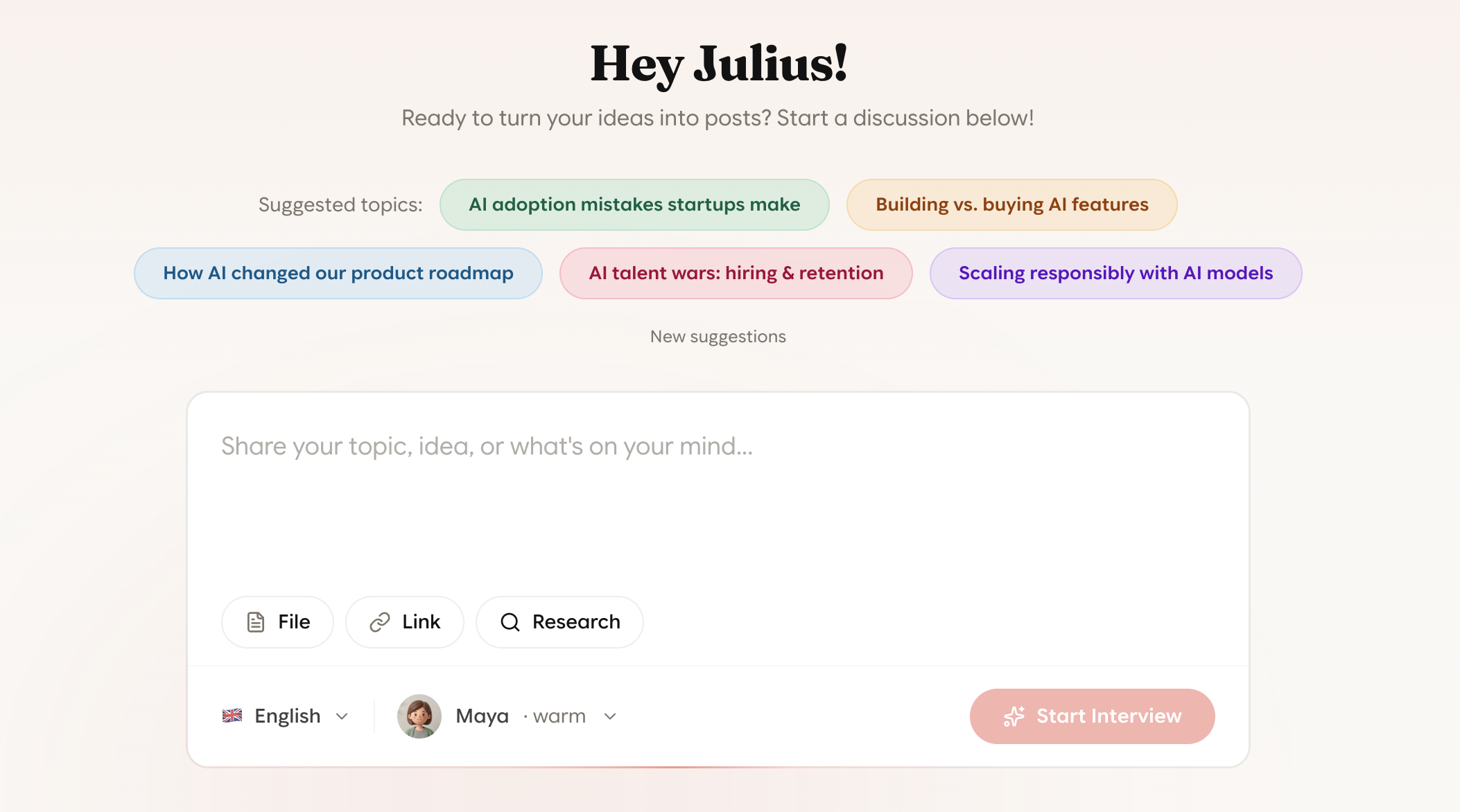
You’re not staring at a blank screen trying to figure out what you want to say. You’re just talking. And the difference in how much comes out is kind of wild.
When I started using it on myself (and I’d posted almost nothing on LinkedIn before this year), my impressions went from 27,000 in the first two months of 2025 to nearly 200,000 in the six weeks after launch. Engagements from 200 to almost 3,000.
Not because I suddenly had better ideas. I’d always had the ideas.
I just finally had a way to get them out.
Making the output not sound like AI
Building the interview mechanic was the straightforward part. The hard part was the output.
You know the tell. That smooth, confident, slightly corporate thing. The “5 ways to optimize your workflow” hooks. The engagement bait. I see posts from people I know personally and there’s zero resemblance between the post and the actual person. Zero. That’s the problem I wanted to solve. Not replicate.
So we went deep. Like, forensic-linguistics-research deep. What makes someone’s written voice actually theirs: sentence length, paragraph rhythm, how they structure an argument, whether they use ellipses or dashes (I’m an ellipsis person, clearly..), their typical post arc, the phrases they reach for before they’ve had a chance to replace them with “better” ones.
The system analyzes your previous posts and your speaking patterns, then generates drafts anchored to your style. Not generic AI style. Yours.
It won’t be right 100% of the time. But if we can get to 90-95%, you’re tweaking a draft, not writing from scratch. That’s the difference between posting regularly and posting never.
Who this is actually for
Not everyone. I want to be honest about that.
This isn’t for people who love writing. Those people are fine. They don’t need this.
It’s for the CEO who knows they should be visible on LinkedIn but hasn’t posted in months because when would they even find the time. The COO, the CTO, the founder who’s too deep in the work to write about the work. The consultant who’s brilliant in client conversations but has posted twice in three years. The mid-level manager who’s solved problems the C-suite should hear about but doesn’t think anyone cares. The technical expert who can explain absurdly complex ideas when asked but freezes the moment someone says “create content.”
People who have plenty to say. They just need to be asked.
One early user put it better than I could: “It helps me stop posting about things I don’t know about and start posting about things I actually do know about.”
And it turns out it’s useful beyond just posting. Several users have told us they use it as a thinking tool even when they don’t end up publishing anything. The interview format helps them work through ideas, clarify what they actually believe, figure out where the gaps are. A thinking companion as much as a posting companion.
(I didn’t expect that. But it makes sense.)
Fifteen minutes to find out
We’re early. Still refining. Still figuring out a lot of it, honestly.
But if you’ve ever stared at a blank post and walked away.. it’s worth 15 minutes to see what comes out when someone just asks you the right questions.
Ready to find out what you have to say?
Start for free